Mergest Kingdom: Merge game
- 4.5
- Rating
- 5.00M
- Installs
- Free
- Price

 Analysis by App-foxy
I spent time with Mergest Kingdom as a relaxing merge-and-build game, and its basic appeal became clear quickly: combine matching objects, open up a magical setting, and gradually turn a messy board into something that feels organized. It belongs to the simulation category, but it plays more like a gentle puzzle adventure than a serious management simulator. That distinction matters because the pleasure comes from small decisions and visible progress, not from deep economic planning.
The game is free to start, suitable for Everyone, and was released on April 7, 2021. Slimmerbits LLC is the developer, and the game has reached over five million installs. Its average rating sits at 4.5 from around seventy-seven thousand ratings, with roughly two thousand reviews. Those figures suggest that the central merge loop has found a sizable audience, but they do not remove the need to look closely at how progress feels over time or how optional spending fits into the experience.
How the merge loop feels after the first session
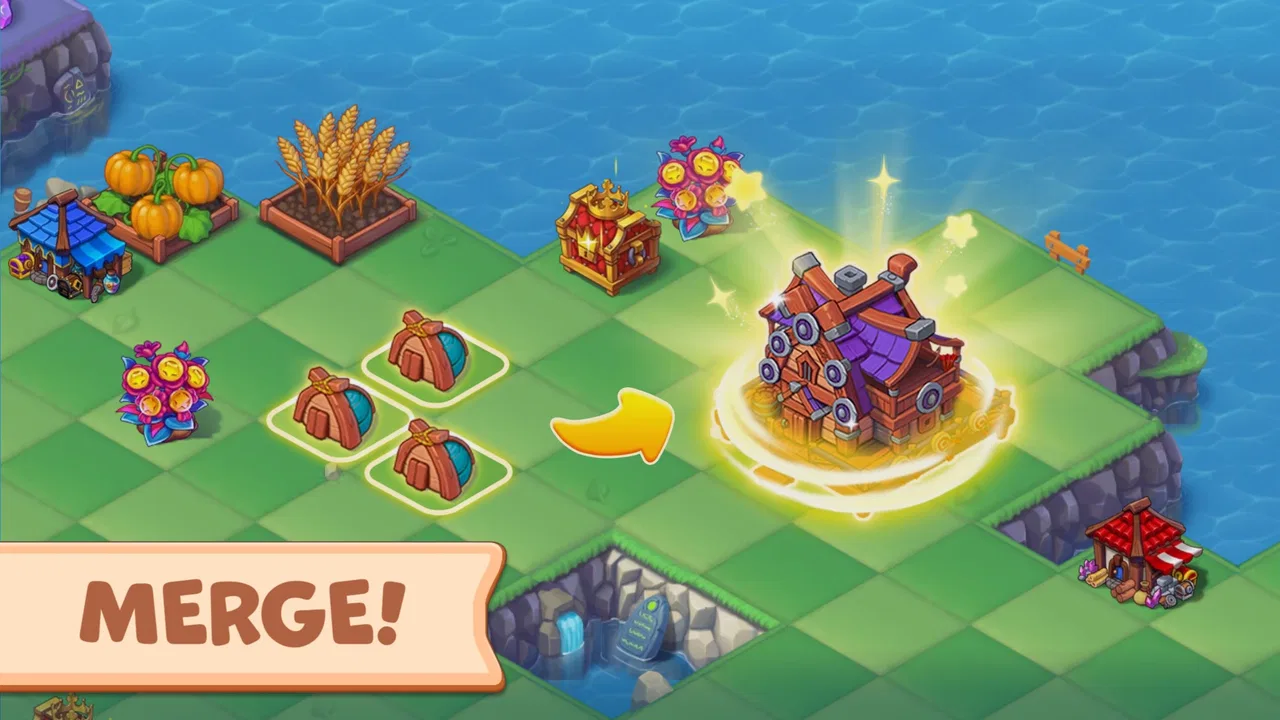
The main activity is easy to understand: find matching items, bring them together, and use the result to make room for more objects or advance the surrounding kingdom. I like that the board gives me something physical to manage. Instead of tapping through menus and watching numbers rise, I can see the consequences of each combination. A crowded area feels like a problem, while a neatly arranged space feels like a small personal achievement.
You May Also Like

 Blood Strike: 2.5 Anniversary
Blood Strike’s Loadouts Turn Every Drop Into a Tactical Gamble
A close look at Blood Strike’s custom loadouts: how fast access to signature weapons reshapes its battle royale rhythm, rewards preparation, and narrows the gap between fights.

 Pandora - Music & Podcasts
Pandora’s Music Is Easy to Start, but Harder to Recover
Pandora’s strength is its low-effort path from a seed to a station. Its weak spot is how much confidence it asks you to place in connection, setup, and quiet recovery.

 8 Ball Pool
 Is Built on Rivalries, Rematches, and Routine
A close look at the rivalries, rematches, shared routines, and unanswered safety questions that turn a quick pool match into a persistent mobile community.

 Samsung Music
’s Quiet Strength Is Playing What You Already Own
Its reach comes less from spectacle than from dependable access to a personal library. That simplicity is both the app’s strongest retention engine and its ceiling.

 AccuWeather: Weather Radar
AccuWeather Review: A Quick, Clear Forecast for Everyday Decisions
For everyday plans, the best forecast is the one you can understand quickly. AccuWeather makes rain timing, radar, and local conditions easy to act on, with a few trade-offs.

 Hill Climb Racing
Why Hill Climb Racing Still Turns Crashes Into One More Run
A tiny car, a bumpy hill and one more upgrade: Hill Climb Racing keeps resurfacing because its simple chaos makes every near-miss feel personal.
More From Our News Desk



That visual organization is one of the strongest parts of the game. I often found myself making a quick plan before merging anything. If I combined objects immediately, I might gain a better item but lose useful space. If I waited and grouped similar pieces first, I could make several combinations in a more controlled order. This is a simple habit, but it makes the game feel more thoughtful than a basic matching exercise.
The setting also gives the routine a softer personality. The magical gardens and dragon-related objects make the board more inviting than a plain collection of colored tokens. I do not need to treat every move as a puzzle with one perfect answer, yet the fantasy theme gives each improvement a sense of purpose. I am not merely clearing icons; I am gradually shaping a place that looks more complete.
Small decisions matter more than fast tapping
My most useful approach was to avoid merging the first available pair automatically. I kept related objects close together, left a little working space around them, and only completed a larger combination when I understood what it would do to the board. This is especially helpful during short sessions, because a rushed move can create clutter that takes longer to resolve than the original merge took to make.
Another practical tip is to treat open space as a resource. A new object is not always valuable if it leaves the board harder to manage. I found it better to finish one small area before spreading attention across the whole kingdom. That workflow reduces visual noise and makes it easier to notice which objects can be combined next.
This is also where the simulation label makes sense. The game is not asking me to run a realistic kingdom, but it does ask me to balance space, timing, and gradual improvement. Players who enjoy tidy layouts and incremental goals will probably understand the appeal immediately. Players who want constant action may find the pace too quiet.
Progress feels comfortable, but not completely frictionless
Early progress is approachable because the rules are simple and the results are easy to read. I can open the game, make a few combinations, and feel that I have done something useful without needing a long uninterrupted session. That makes it a good fit for a commute, a short break, or an evening when I want a game that does not demand intense concentration.
The trade-off is that merge games naturally create periods where the board needs more preparation than action. Once the easy combinations are gone, I may spend time arranging objects, waiting for a better opportunity, or deciding which chain deserves attention. I do not consider that automatically bad; it is part of the genre. Still, anyone expecting a constant stream of new discoveries should know that the rhythm includes quiet stretches.
For me, the best use case is a player who enjoys returning to a project repeatedly rather than finishing a challenge in one sitting. The game works as a background routine: make a few sensible merges, improve the garden, close it, and return later. It is less suitable for someone looking for a compact game with a clear ending after every session.
Spending, pressure, and whether the game feels fair
The game is free to download and play, while its listed in-app purchases range from $0.99 to $129.99 per item. That is a wide range, so I would approach the purchase system with awareness rather than assuming every player will have the same experience. The important point is that optional spending exists at several price levels, including a top-end purchase that is substantial compared with the cost of a casual impulse buy.
I do not think the presence of purchases alone makes the game unfair. A free-to-play merge game needs some way to support ongoing development, and the basic board activity remains understandable without turning the review into a shopping exercise. However, the broad price range means I would not recommend buying anything quickly just because progress feels slow during a particular session. I would first close the game, return later, and see whether the desire to spend remains.
That pause is useful because merge games can make temporary clutter feel more urgent than it really is. When the board is full or a goal seems just out of reach, a paid shortcut may look attractive. My advice is to treat purchases as optional convenience rather than as part of the core strategy. If a player dislikes any game that places paid options near a slow progression loop, this may not be the right choice even if the merging itself is enjoyable.
What I can and cannot say about competitive fairness
This is primarily a personal progression game for me, not a title I would choose for serious competition. The satisfaction comes from improving my own board and developing my own rhythm. Because of that, fairness is less about defeating another player and more about whether my progress feels like the result of decisions rather than spending.
I would not describe the game as an esports-style contest, and I would not compare it directly with a competitive puzzle game where every player receives the same timed challenge. A player who wants rankings, head-to-head matches, or a strict skill test would probably be better served by a dedicated competitive alternative. Mergest Kingdom is more comfortable as a personal, low-pressure activity.
At the same time, personal games can still create pressure. A crowded board, a desirable upgrade, or a slow period can encourage impatience. I found the experience fairest when I played at my own pace and resisted treating every blocked move as a problem that needed an immediate solution. That mindset preserves the relaxing side of the game and prevents the purchase menu from becoming the focus.
Who should try it, and who should skip it
I would recommend it to people who enjoy organizing spaces, combining objects, and watching a setting improve gradually. It is also a good match for casual players who want a game that can be understood quickly but still rewards planning. The Everyone rating makes it broadly approachable, although younger players should still have a parent or guardian involved in decisions about optional purchases.
I would be more cautious recommending it to players who need a fully transparent progression model, dislike waiting between meaningful actions, or want a premium game with no purchase prompts. It may also disappoint people who expect the simulation category to offer detailed resource management, construction systems, or a complex economy. Its simulation identity is light and decorative compared with a dedicated city builder or life simulator.
Compared with ordinary match-three games, the appeal here is persistence. A typical match-three round gives me a contained board and a clear finish, while this game asks me to keep developing a larger space over time. Compared with a traditional kingdom simulator, it is much easier to pick up but much less concerned with detailed planning. Compared with a purely decorative garden game, the merge mechanic gives me more to think about, although the focus remains on gradual collection and arrangement rather than freeform design alone.
A realistic everyday session
Imagine opening the game during a fifteen-minute break. I would first scan the board instead of tapping immediately. I would group matching pieces, identify the area with the most clutter, and make the safest combinations there. If a merge created a higher-level object but blocked several other items, I would consider leaving it until the surrounding space was ready. After a few moves, I could stop with a cleaner board and a visible improvement without needing to complete a long objective.
That scenario captures the game at its best. It gives a small sense of accomplishment without demanding that I remember complicated controls. The session can be active when combinations are available and more contemplative when the board needs arranging. For a player who likes checking in several times rather than playing continuously, that rhythm is a strength.
The same scenario also shows the main limitation. If I open the game expecting a fresh burst of action every time, I may instead find that the useful move is to organize and wait. That can be calming, but it can also feel repetitive. My enjoyment depends heavily on whether I see board management as part of the game or as an obstacle between rewards.
Details I would watch before spending
The purchase range is the clearest financial consideration, but I would also watch my own behavior. If I start opening the game mainly to chase one missing object, or if I feel annoyed whenever progress slows, the game has stopped serving its relaxing purpose. In that situation, spending is unlikely to fix the underlying mismatch between my expectations and the design.
I would also keep the game separate from a child’s unsupervised device if purchases are enabled. The Everyone rating describes the broad content suitability, not a guarantee that every player will make careful buying decisions. A simple household rule—play freely, but ask before purchasing—would make sense here.
There are also some practical unknowns I would not fill in with assumptions. The purchase facts establish the available price range, but they do not by themselves explain how often offers appear, how much each purchase changes progress, or whether every player encounters the same prompts. I would therefore judge the game through normal play first, and only consider spending after understanding what a particular offer actually provides.
My trust verdict after weighing the whole experience
My overall view is positive but measured. The merge mechanic is accessible, the magical setting gives the board personality, and the gradual garden-building loop works well for short, relaxed sessions. I especially appreciate that careful placement can make a real difference; the game is not only about tapping pairs as quickly as possible. Planning around space is the small strategic layer that keeps the routine from feeling completely automatic.
Its weaknesses are equally clear. The pace can become slow, the board can feel crowded, and the free-to-play structure deserves attention because purchases range from a very small amount to a much larger one. I would not call it the best option for competitive players, players who want a one-session puzzle, or anyone who strongly prefers a fixed-price experience. Those readers may be happier with a premium merge game or a traditional match-three title.
For everyone else, I think the safest way to approach it is as a gentle long-term hobby rather than a game to rush. Use the board deliberately, protect open space, and let progress happen over several visits. Most importantly, decide in advance whether optional purchases fit your budget and your expectations. The game is at its most enjoyable when the merge decisions—not the spending—remain the reason you return.
That is why I would recommend giving Mergest Kingdom a try if you enjoy tidy layouts, fantasy decoration, and incremental goals. Start free, play slowly, and judge the experience by how satisfying the board feels when you make your own progress. If that personal sense of improvement is enough, the game has a pleasant niche. If you need fast action, deep simulation, or completely purchase-free design, choosing another style of game will likely be the better decision.
FAQs for Mergest Kingdom: Merge game
01What is Mergest Kingdom: Merge game?
Mergest Kingdom: Merge game is a casual puzzle and kingdom-building adventure in which you combine matching objects to create improved resources, complete quests, and expand a magical island. As you merge materials, plants, tools, and other items, you gradually unlock new areas and characters. The game mixes relaxing merge mechanics with exploration, collection, and light strategy elements.
02How do you play Mergest Kingdom: Merge game?
The main gameplay is based on merging three or more identical objects. Combining items produces a more advanced version, which can then be merged again to create increasingly valuable resources. You use these objects to fulfill orders, complete tasks, clear obstacles, and develop your kingdom. Managing limited board space is important, because careless merging can quickly make the island feel crowded.
03Is Mergest Kingdom: Merge game free to download and play?
Mergest Kingdom: Merge game is generally free to download and offers a free-to-play experience. However, it may include optional in-app purchases for premium currency, boosters, energy, special bundles, or faster progress. You can play without spending money, but some activities may require waiting for resources or energy to refill. Parents should review purchase settings before allowing children to play.
04Does Mergest Kingdom: Merge game require an internet connection?
An internet connection may be needed for certain features, including loading events, synchronizing progress, displaying advertisements, processing purchases, and accessing online content. Some basic gameplay may work temporarily when you are offline, but the experience can be limited and progress may not synchronize correctly. For the most reliable performance, it is best to launch and play the game while connected to a stable network.
05Is Mergest Kingdom: Merge game suitable for children and casual players?
The game is designed for casual players and is easy to understand, making it approachable for many ages. Its colorful presentation, simple controls, and gradual progression make it suitable for players who enjoy relaxed puzzle games. Nevertheless, it may contain advertisements, optional purchases, timers, and reward systems. Adults should check the store rating and configure parental controls according to the child’s age.
Pros
- Relaxing merge gameplay suitable for short or extended sessions.
- Large collection of buildings
- characters
- and objects to discover.
- Quests provide clear goals and help maintain steady progress.
- Colorful visuals and friendly animations make the kingdom appealing.
- Playable offline in many situations
- making it convenient while traveling.
Cons
- Energy limits can interrupt progress during longer play sessions.
- Some upgrades and rewards require considerable time to unlock.
- The crowded game board can become difficult to organize later on.
- Optional purchases may feel tempting when resources run low.
- Repeated merging tasks can become monotonous over time.

Mergest Kingdom: Merge game
Gallery